Launch Control Core
The Main Features part is split into 4 segments: “Vehicle Collection, Rigging, Animation, and Real-Time Physics”.
Let’s go over each of those here.
Vehicle Collection
The Vehicle Collection field allows a Multi-Car Workflow in LC and keeps track of the Active Car.
Select a Collection, which holds the vehicle you want to rig by dragging the collection from the outliner into the field or by browsing the available options by clicking the field
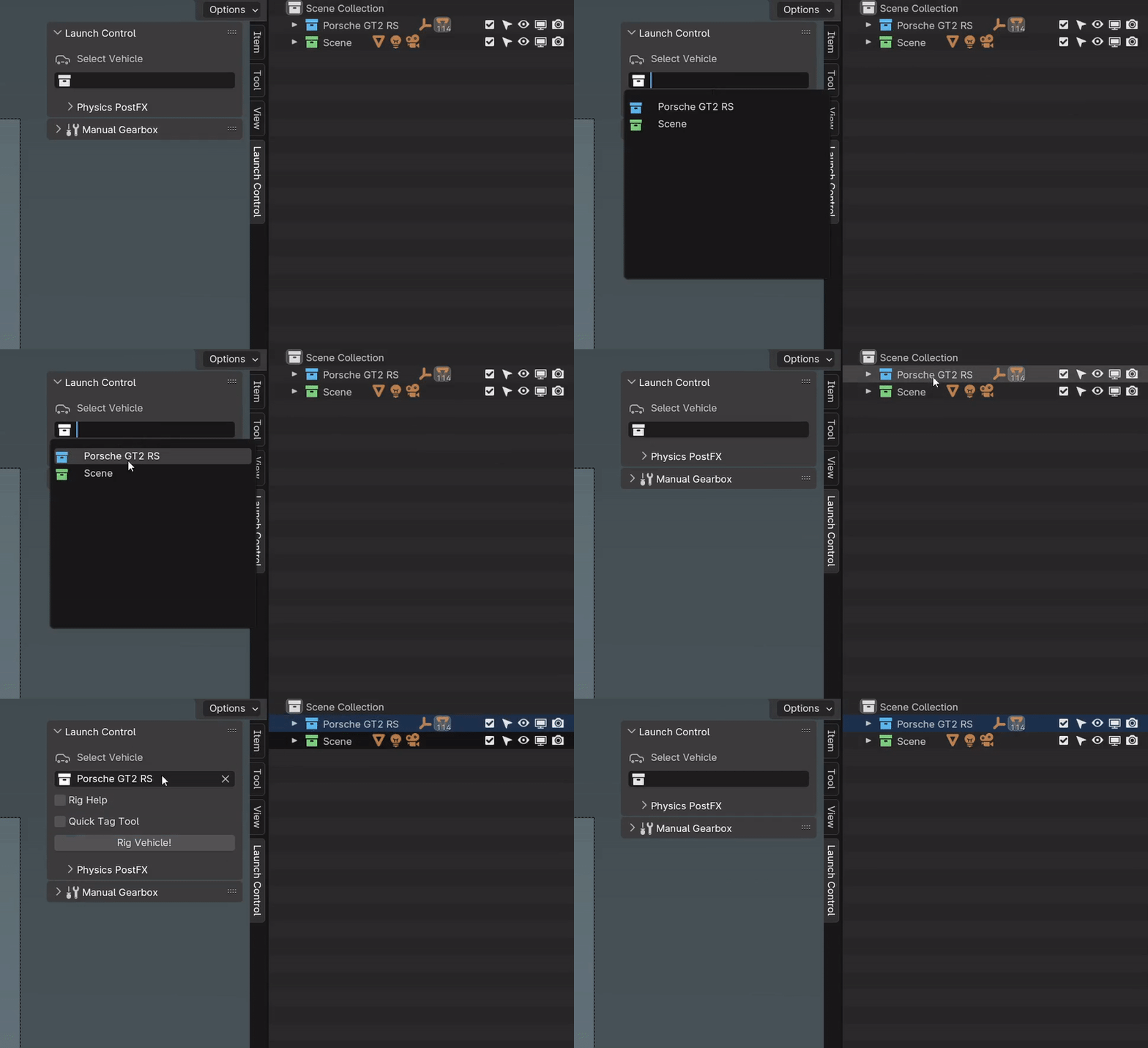
Selecting a Vehicle Collection
Warning
Rigging vehicles across Blender Scenes is not supported. Please only use 1 scene for rigged Launch Control Vehicles in each file.
Note
Avoid Copy/Pasting, Appending or Linking Vehicles that are rigged using Launch Control. If you want to move a vehicle to a new file, unrig the vehicle and rig it again in the destination file.
Rigging
LC uses Rigging Tags to detect the parts of the vehicle. If the naming convention of the 3D model is supported by LC, the rigging can be done with one click.
Quick-Tag Tool can be used to prepare unsupported 3D models to work with LC with a few clicks.

Rigging with Quick-Tag Tool
Custom Tags can be used to optimize LC for your own naming convention.
Quick-Tag Tool
You can quickly tag Car Parts that needs renaming to be compatible with LC using the Quick-Tag Tool. Select a Car Part (for instance the Car Body) in the viewport, and hit, “body”, to tag the selected object as the body of your car. Do the same for wheels and the brake calipers and headlights if desired.
“FL, FR, RL and RR” referes to the location of the car part and respectively means: “Front Left, Front Right, Rear Left and Rear Right”.
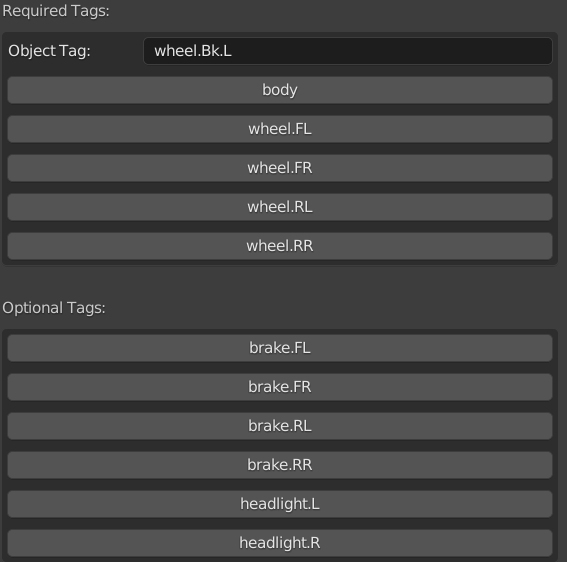
The Quick-Tag Tool in the Interface
CAD Data Setup
For manufactureres data-sets the CAD Setup can be used. This optimizes the rigging process for those types of data-sets. Drag and drop empties into the corrosponding assembly fields, input the ‘Vehicle Data’ and hit ‘Rig Vehicle’ to get started.
To reveal this process, head into “User Preferences -> rigging-preferences”
- Assemblies:
Body: The overall empty holding the entire data-set. Origin/Pivot location is irrelevant
Anim Rot XX: The empties holding the wheels. Anything that spins and rotates.
No Rot XX: The empties holding the brake calipers or any other objects which do not spin (but still turns for front wheels)
- Vehicle Data:
Tire Width: The width in Millimeters of the rear tires of the car
Tire Aspect Ratio: The aspect ratio between width/height of the rear tires of the car
Rim Diameter: The diameter in Inches of the rim in the rear of the car
Wheel Diameter Rear: The diameter in Meters of the tire in the rear of the car. Calculate this value using the input fields above or input it manually
Wheel Camber Amount: The amount of camber in degrees on the wheels in rest position
Emulated Body Weight: Automatically drop the body of the vehicle slightly to immitate the weight of the car, which will compress the springs
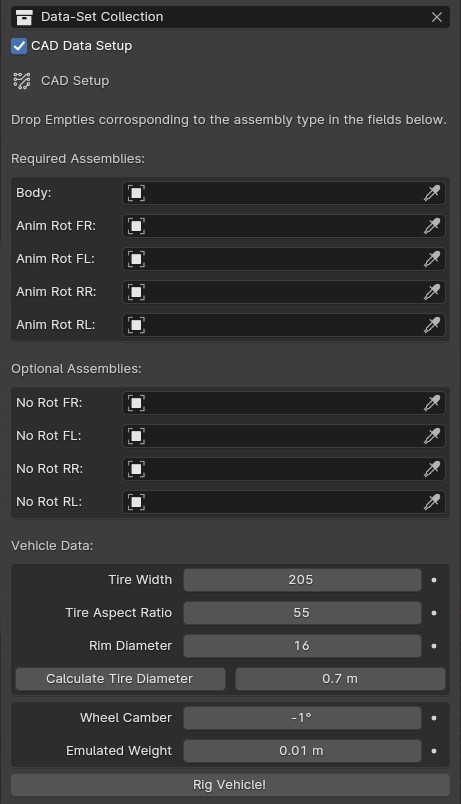
The CAD Data Setup menu can be used for rigging manufactureres data-sets
Asset Packs for LC
Many Vehicle models have supported naming conventions out of the box. Some Asset Packs that are natively supported are:
Linked Vehicles with Library Override
In Launch Control, you can rig a vehicle linked from another file. To do so, add a Library Override to all the objects you have added Rigging Tags to and hit “Rig Vehicle!”
Troubleshoot Rigging
If any issues were found during rigging, LC will promt you with a message about which body part was missing. The objects tagged as “Wheels” need to be the tire meshes of the vehicle. The objects tagged as “Body” and “Brakes” can be empties.
In some cases, the rigging is succesful, but inacurate, which can cause shaking or wobbly wheels. This is usually due to one of 3 things:
The L/R Rear or L/R Front wheels are not properly alligned in pairs
Any of the wheels had a rotation offset or the geometry was not straightned before rigging
The Tire Mesh does not have evenly distributed geometry (See Automatic Tire Pivot)
Note
Custom rigging and parenting can be done using the Garage Mode
Animation
LC uses a curve based animation workflow to give you full creative control over the movement. User Animation is acting on top of the automatically calculated animations, allowing the user full customization of the animation.
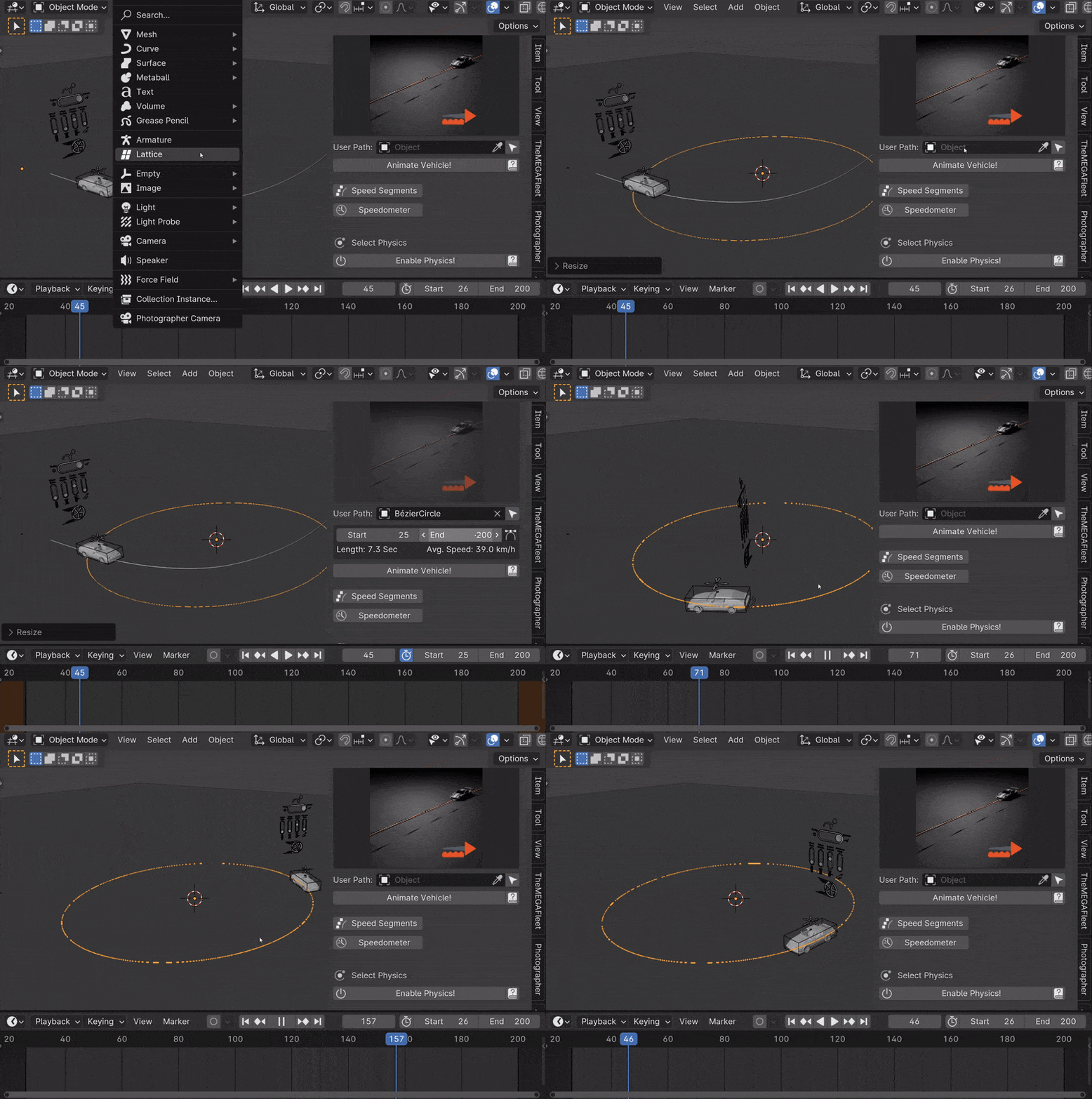
Animating with a User Path
Driving Path
The curve which the vehicle is following is called “Driving Path”. It can be modified by selecting it and going into “Edit Mode”. In Edit mode you can also use the “Draw” or “Curve Pen” tool on the left sidebar to alter the Driving Path.
Animation Presets
To quickly try out animations use the presets. Select a Preset from the Gallery and hit “Animate Vehicle”.
User Path
To use your own “Bezier Curve” or “Nurbs Path” to animate the vehicle along, use the “User Path” field. Click the field to browse for your desired path or drag-n-drop the path into the field. Hit “Animate Vehicle”.
The Vehicle will automatically be animated to drive along the length of the path over the scene time.
Note
If a “User Path” is selected, it will overrule/gray out the animation presets.
Warning
Do not delete the Driving Path object. Instead create your new path and use the new path in the User Path Field.
Update Driving Path
While adjusting the control points of the Driving Path, the total length of the path might change. When this happens, LC will prompt you to “Update Driving Path” before adjusting any animation. Click “Update Driving Path” button in the LC interface. - This will resolve any offsets to the animation that might be due to the changed Driving Path.
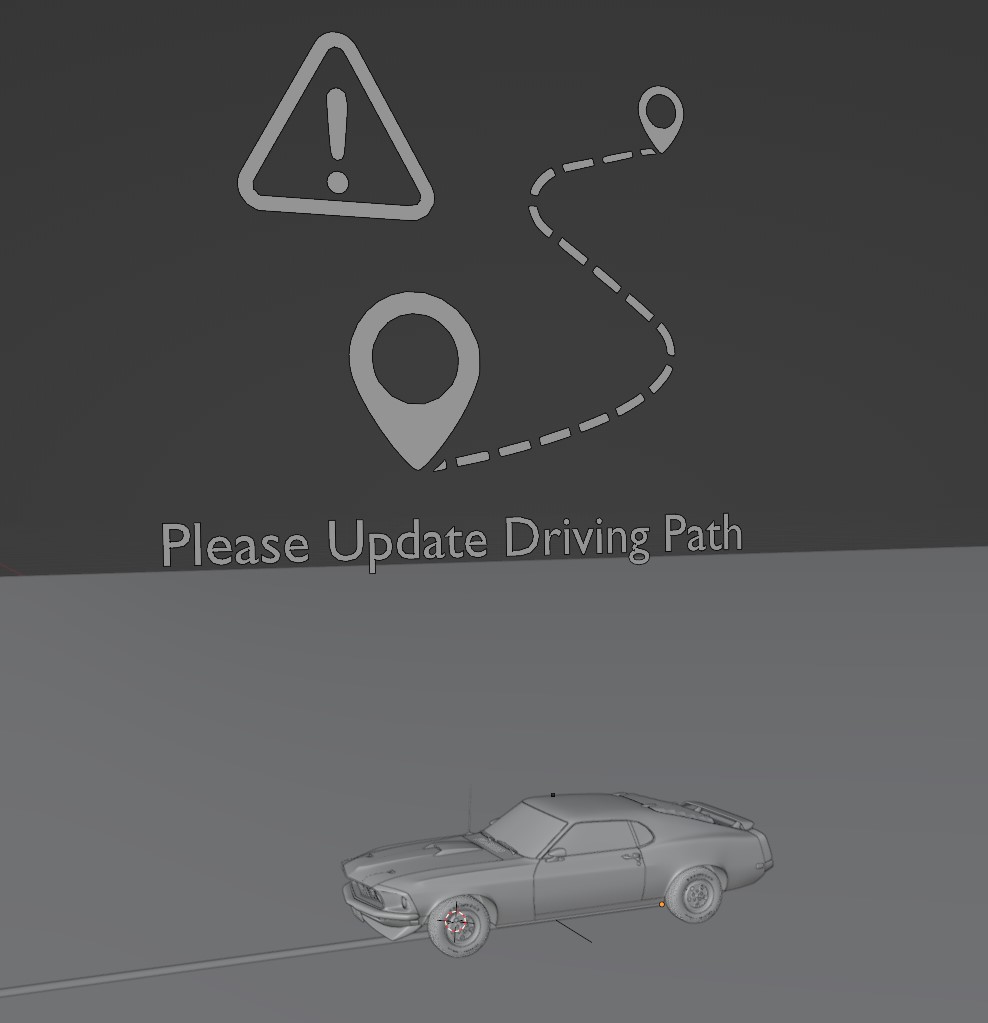
Update Driving Path Message in 3D View
User Animation
Much of the movement is calculated automatically by LC as the vehicle is following the path - This includes: Steering, Wheel Rotation, Suspension, Camber/Castor. User Animation is what the user optionally can change to make the vehicle move more uniquely. Animation Controls in the viewport are used to animate this.
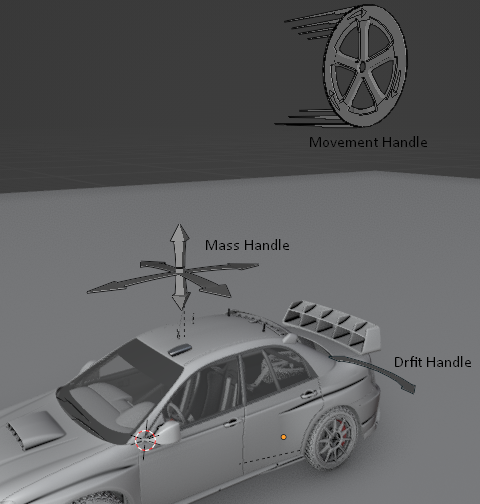
Handles for User Animation
Go into “Pose Mode” to adjust any of the Handles. After adjusting a Handle hit “I” on the keyboard and pick “Location” or “Rotation” depending on which Handle you are animating to add a keyframe to it.
Speed Handle needs keyframes on: Z-Rotation
Mass Handle needs keyframes on: Location
Drift Handle needs keyframes on: Y-Rotation
Note
Animating the movement/speed of the Vehicle can be done with a Graph Editor open. The inclination of the animation curve at any point determines the speed at the given time.
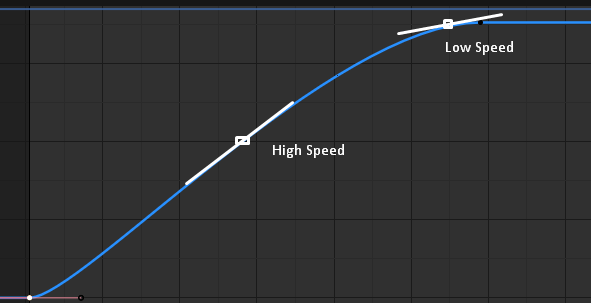
The Inclination determines the Speed
Ground Detection
The vehicle will automatically detect any ground objects which are added to the collection called “Ground Detection” To add additional objects which will act as ground detection move them into this collection or use the Ground Colliders list.
Using the Snap Driving Path you can make the control points of the Driving Path snap to the ground detection objects.
Note
The threshold for the vehicle detecting the ground is 4 m. If the vehicle is further away than this, it will instead stick to the path.
Speed Segments
Using the Speed Segment tool can speed up the animation workflow by allowing you to adjust visual “Speed Keyframes” inside the 3D view instead of the postition keyframes inside the graph editor.
The Speed Segments are still compatible with - and can be used in combination with - traditional keyframe animation.
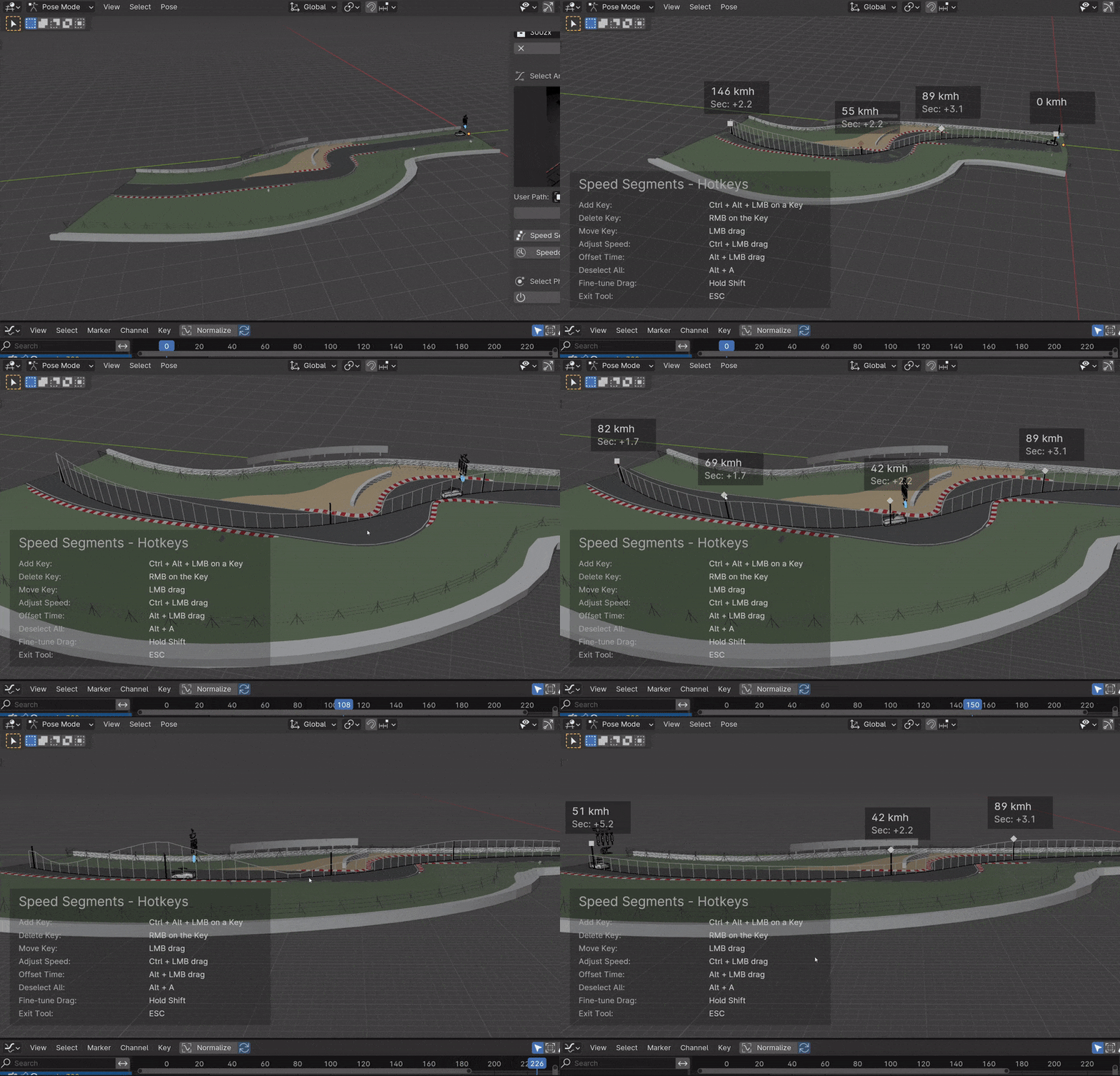
Speed Segments making animation visual
Warning
Auto-save in Blender will be temporarily blocked while the Speed Segment Tool is active. Make sure to turn off the tool when you don’t need it anymore.
The Speed Keyframes can be moved along the Driving Path, the speed of each key can be changed and the offset in time to the previous Speed Keyframe can be altered.
All this is done in the 3D viewport using the Hotkeys:
- Add Key:
Ctrl + Alt + LMB on a Key
(Will add a key between the pressed key and the previous key) *
- Delete Key:
RMB on the Key
- Move Key:
LMB drag
- Adjust Speed:
Ctrl + LMB drag
- Offset Time:
Alt + LMB drag
- Deselect All:
Alt + A
- Fine-tune Drag:
Hold Shift
(This can be used for dragging keys and adjusting speed or time offset)
- Exit Tool:
ESC
Speed Segments Settings
In the settings you can alter the way the Speed Segments are shown and how they work.
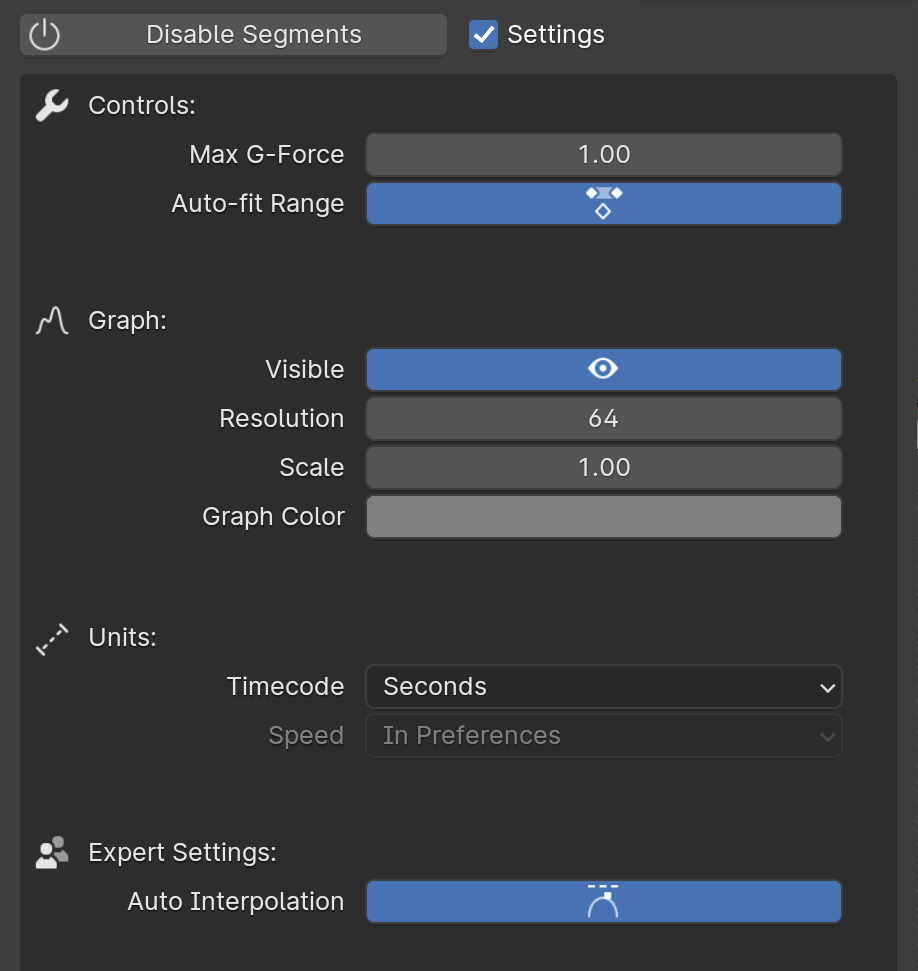
Exposed Speed Segment Settings
- Controls
Max G-Force: The tool estimates G-Forces. The tool will automatically increase the time inbetween 2 Speed Keyframes to make sure accelerations are not exeeding the Max G-Force. This only affects the time inbetween keyframes, not the distance
Auto-fit Range: When enabled, the Speed Segments will automatically fit the scene frame range to the total length of the speed keyframe animation
- Graph
Visible: Enable/Disable the graph in the 3D view. (Disabling will improve viewport performance)
Resolution: Set the amount of interpolated speed points in between the Speed Keyframes. The more points, the bigger the viewport perfromance is impacted
Scale: Change the height of the Graph to make small changes in speed more visible
Color: Change the Color of the Graph to make it more visible
- Units
Timecode: Change the unit of the inbetween time shown on each Speed Keyframe
Speed: Change the unit of speed inside the add-on preferences (Edit -> Preferences - Add-ons -> Object: Launch Control -> Animation -> Use Imperial Units)
- Expert Settings
Auto Interpolation: Is ON by default. Turn on to avoid the Speed Segment Tool changing the keyframe tangents automatically. For more customizability of the animation interpolation turn this feature off and set the tangents like desired manually in the Graph Editor.
Speedometer
Checking this box will show a Speedometer hovering over the vehicle in the 3D view. A Speedometer will also be shown in the Add-on UI.
The Units can be changed using Use Imperial Units inside the Add-on Preferences.
Note
The Speed is calculated temporally and can only be calculated correctly when the animation is playing forward in real-time. Use the “Refresh Speed” Button to force LC to calculate the correct speed at the current frame.
Note
The Speedometer in the Add-on UI is only working when the mouse is hovering over the panel. Otherwise this value does not update due to the way Blender works. The Speedometer in the 3D view is not affected by this.
Real-Time Physics
Physics are used in LC to add secondary motion to the vehicle, which is tedious to animate by hand. The Physics are layed on top of the Automatic and User Animation and are fully non-destructive to the User Animation.
Presets can be used to get different results, or use the Customize checkbox to adjust the Physics settings in detail.
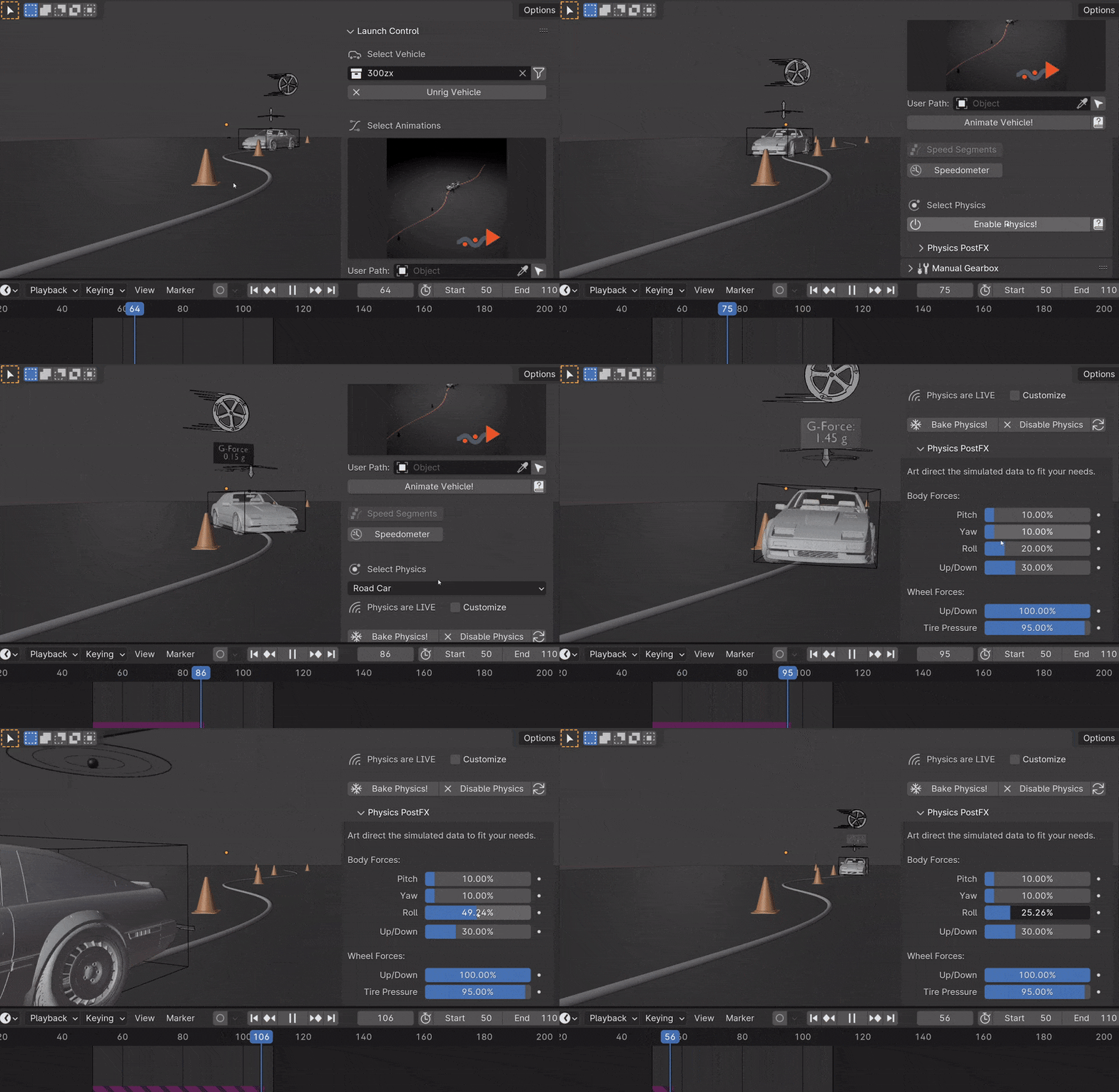
Enabling and adjusting Physics in real time
- The Physics always have one of five states:
Note
The Physics are framerate independent, but are optimized a framerate of 24 fps.
Live Physics
When the Physics are LIVE, they are simulated in real-time when Blender is playing forward.
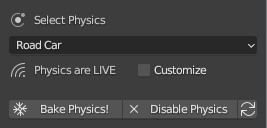
Note
Physics cannot be calculated LIVE when playing backward. LIVE Physics will cache when playing forward. To ensure you are seeing the latest result, revert the timeline back to frame 0 or hit the ‘Reset Physics’-button.
Baked Physics
When the Physics are BAKED, changes to the animation will not affect the physics. The Physics are locked and are ready to be rendered.
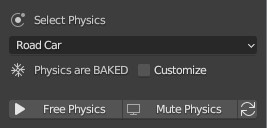
Warning
Due to a bug in Blender, BAKED physics do not load correctly when re-opening the file. After reopening, you would need to bake the physics again.
To bake the physics, click “Bake Physics!”. This will take you to the baking menu, where you can add Warm Up Frames and start the bake with “Confirm Bake!”. LC will mark the area which will be baked in the timeline.
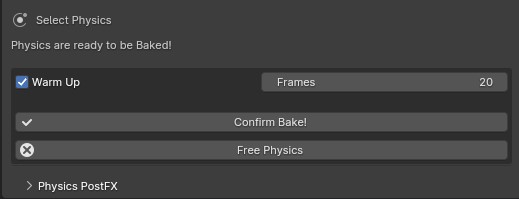
Baking Menu, when a bake has been started
When the bake finishes, click “Revert to Physics Menu”.

When bake finishes, you can revert back to the main Physics Menu
Warm Up Frames
To avoid “popping” on the first frame of the physics you can add warm up frames before your animated section starts. During the baking process you have the option of enabling this and setting the amount of frames.
Note
It’s only possible to add warm up frames if your animation starts after frame 0 of the scene timeline. Warm up frames can not be negative frames.
Muted Physics
When the Physics are MUTED, the baked physics motion is kept, but disabled temporarily. The vehicle will only have the motion from the animation. Hit the Unmute button to show the baked physics motion again.
Outdated Physics
When the Physics are OUTDATED, they have been baked, but changes in the scene or the physics settings have made the bake invalid or outdated. Please bake the physics again if this is the case.
Invalid Physics
When the Physics are INVALID, you will need to hit the “Reset Physics” button to update them. If the Physics are BAKED, this will launch a re-bake. If the Physics are LIVE, it will instead clear the real-time cache, resolving the issue.
G-Force Vizualiser
To make it easier to debug what the Physics are doing a G-Force Vizualiser is showing up above the vehicle when the physics are turned on. It can be disabled inside View in the “Manual Gearbox”. When the G-Force exceeds 1.8 g, the vizualiser turns red indicating that a big force is acting on the body. To decrease the magnitude of the force, decrease the acceleration of the vehicle or make turns smoother.
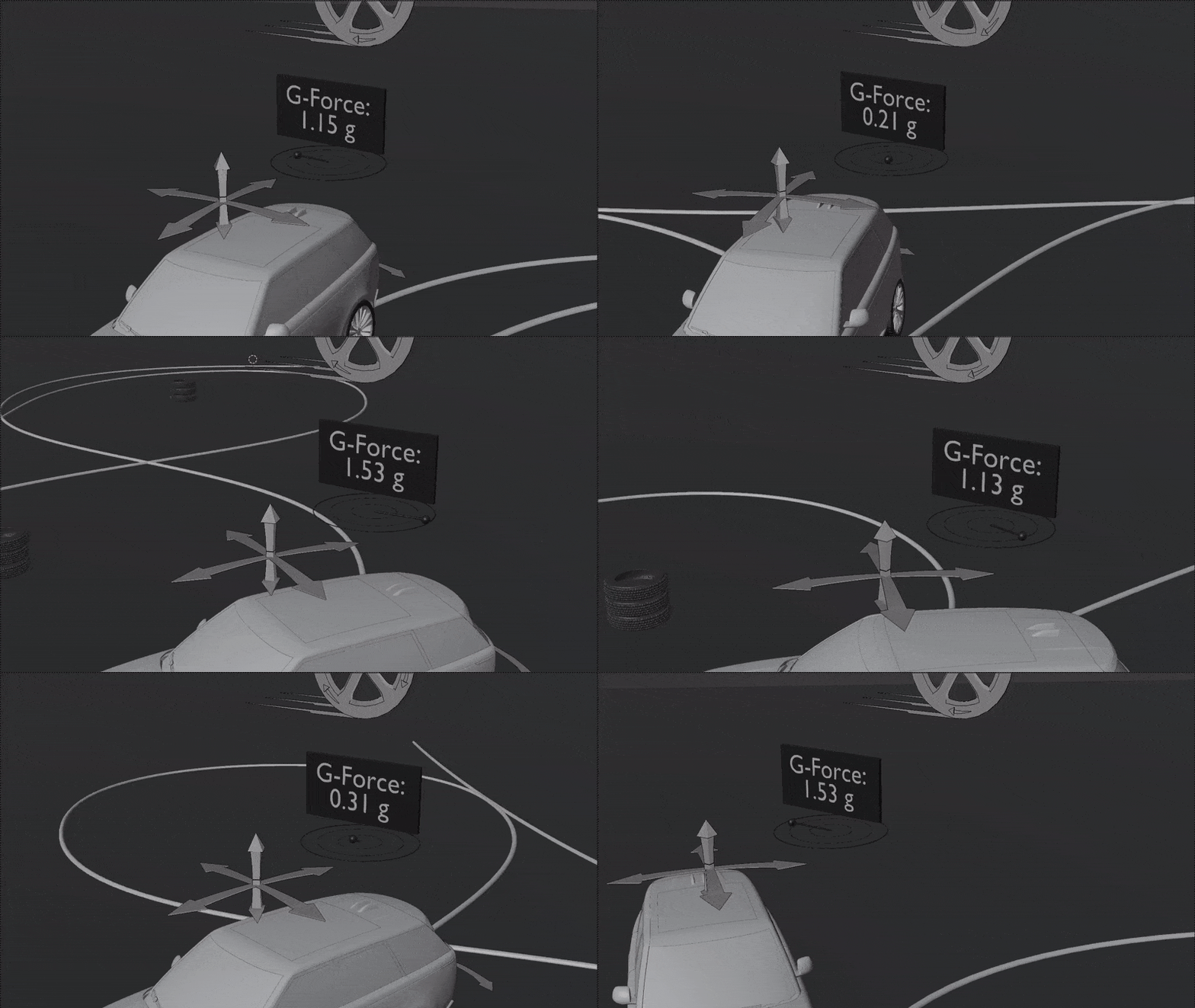
The G-Forces which are working on the vehicle
Note
LC uses a physically plausible simulation engine, but take the values with a grain of salt. It only indicates the approximate value for you.
Customize
By checking to “Customize” box, a list of sliders will be revealed. These sliders can be used to adjust the parameters used when simulating the physics. If the Physics are Baked, you would need to re-bake to see the result of the change.
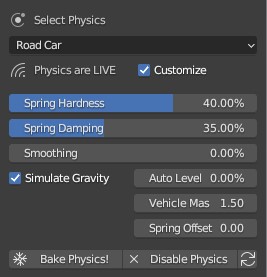
Physics can be customized in the Interface
- Spring Hardness:
The ‘Tightness/Hardness’ of the Spring. Increase this to have the Spring be harder and respond faster (Feeling of a light vehicle or road/track vehicle), decrease this to make the Spring respond slower and feel softer (Feeling of a heavy offroad vehicle).
- Spring Damping:
How quickly the spring stops moving after an impact. A low value makes the spring wobble for a long time after an impulse.
- Smoothing:
Adds extra smoothing to the ride. Makes the response slower and dampens more of the forces. Equivilant to Decreasing ‘Hardness’ and Increasing ‘Dampening’ at the same time.
- Simulate Gravity:
Let the physics take care of the Gravity when the vehicle is in the air. When ‘ON’ the vehicle might deviate more from the Driving Path during jumps. When ‘OFF’ the car will stick ‘tightly’ to the path, even if it would be physically impossible - This is useful for making the car do loops or running over a bumpy road in a controlled manner
- Auto Level:
During airtime, the vehicle can start to nose-dive or pitch backwards. Using Auto Level, you can bias the physics toward keeping the vehicle level rather than pitching or rolling.
- Vehicle Mass:
Similar to ‘Spring Hardness’, affects how much the car is affected by impacts from the road. Increase this to make the bumps and landings have less impact on the body motion of the vehicle and vice-versa.
- Spring Offset:
Fine-tune the physics Suspension Height. This is only affecting the car when physics are turned on.
Warning
When “Spring Offset” is set too high, the car will keep bouncing.
PostFX
To make it easier to art direct the Real-Time Physics, use the PostFX to adjust the influence of the forces acting on each Axis of Rotation and Location. PostFX can be animated as well.
Body Forces:
- Pitch, Yaw, Roll:
The physics influence on the body of the car in each of the 3 rotation axis.
- Up/Down:
The physics influence on the up/down movement of the body of the car.
Wheel Forces:
- Up/Down:
How much an impact from the ground affects the wheels up/down movement. (During jumps or when running over bumps)
- Tire Pressure:
How much the tires are allowed to clip through the floor (To simulate low pressure inside the tires when they have a hard impact with the ground).